Sunday, April 18, 2021
No Holds Barred: Kevin Carter on the Rise and Decline and Rise of Sumo in America (Part One)

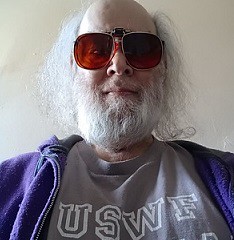
On this edition of No Holds Barred, host Eddie Goldman spoke with sumotori, judoka, writer, and intellectual Kevin Carter. This is the first of a two-part interview.
We spoke with him by phone Wednesday, April 14.
For Kevin Carter, sumo has been a lifelong passion.
While growing up, "I would come home after school, and the only thing I really watched on TV was sports," he said. "I watched a lot of baseball, football, basketball. I also played hockey, too. But I was watching every Saturday that I could, and very occasionally they'd put on sumo.
"I immediately fell in love with sumo. It was like, 'this is great, man!' These are guys who are obviously athletes."
This was in the late 1960s and early 1970s, and many of the greats of Japanese sumo at that time were sometimes featured on the sports highlight shows of that era.
"I just totally fell in love with sumo."
He still had not competed in sumo, though. When he was at Harvard, he played football. He had developed an affinity for Japanese culture by the time he began a career in journalism, covering sports for the Philadelphia Inquirer. Later he began writing about culture, music, and arts for that newspaper.
One day while watching Philadelphia's channel 10 (WCAU-TV, which was a CBS station at that time), he saw a feature on a huge African-American wrestler named Manny Yarbrough. He immediately resolved to do a story on him. That led him to interviewing both Manny Yarbrough and his judo and sumo coach, Yoshisada Yonezuka, who ran the Cranford Judo Karate Center in Cranford, New Jersey.
It proved to be a life-changing moment. "I want to do this, too," he said, and so he did, in both sumo and judo.
Among the sumo events in which he competed, he recalled, was a special U.S. vs. Canada tournament in 1993 in Hamilton, Ontario. He finished with a record of 9-6 and won a technique prize.
He continued training with Manny Yarbrough, who was having greater success than him. In 1992, the first amateur sumo world championships were held. Manny Yarbrough won a silver medal that year in the open weight division, the first of five world medals he would win. In 1995, Manny Yarbrough won a gold medal at the amateur sumo world championships, still the only American to win a world championship at this event.
Many members of the U.S. team at that time were Hawaiian. Kevin Carter described that period as a "dynasty of Hawaiians in amateur sumo." Sumo had become popular in Hawaii at least as early as the 1960s, and was a school sport there as well. In 1995 and 1996, he did his graduate work in Asian history at the University of Hawaii, and had a chance to train and compete in sumo while there.
After a brief foray into MMA, Manny Yarbrough went from amateur sumo into a venture trying to establish professional sumo in the U.S. In 1998, an event called "Night of the Giants" was held in Atlantic City, New Jersey, at what was then the Trump Taj Mahal. It was taped for delayed showing on ESPN, and Kevin Carter worked with the show's promoters as a TV commentator and in helping run the tournament.
But many things went wrong with the show. First off, the promoters wanted to build it around Manny Yarbrough, who by that time had built a following, especially in that region. But Manny lost in the first round of the tournament, which was eventually won by Mark Robinson, who had already defeated him in the 1996 amateur sumo world championships. In addition, there was no agreement on how this show and event would be positioned. Many of the people running it wanted it to be a spectacle, a la the WWF of that time, while others, like Kevin Carter, wanted it run like a sport. With all these problems, he said, the show was "one and done."
That failed event and what was happening in general with American sumo would also prove to be the beginning of the end of Kevin Carter's involvement in the sport, at least for some time. We will discuss that more in the upcoming second part of our interview.
Please also subscribe to the No Holds Barred page on Patreon for much more No Holds Barred content.
You can play or download No Holds Barred on Podomatic and the Internet Archive. If one link does not work, please try another.
No Holds Barred is also available on these sites and apps:
The Podomatic Podcast Player app is available for free, both for Android at Google Play, and for iOS on the App Store.
The No Holds Barred theme song is called "The Heist", which is also available on iTunes by composer Ian Snow.
No Holds Barred is sponsored by:
LenneHardt.com, the home of Lenne Hardt, the legendary MMA and sports announcer, voice actor, singer, actress, and comedienne. Lenne is also known for her jazz vocals with her Lenne Hardt Jazz Cabaret Band. For more information, to book her, or to order a custom message from her, go to LenneHardt.com.
Skullz Fight Shop, home of the Skullz Double-End Bag, the perfect punching bag for your combat sports training. Skullz Double-End Bags provide a realistic striking target, and help improve speed, distance, and timing skills. Hang it and hit it right out of the box! No pump required. Skullz Fight Shop - Advancing combat sports equipment for the next generation of fighters. For more information, go to https://skullzfightshop.com.
Adolphina Studios. Original art prints and handcrafted fine jewelry. For more information, go to https://www.etsy.com/shop/AdolphinaStudios.
Labels: Eddie Goldman, Kevin Carter, Manny Yarbrough, No Holds Barred, sumo, wrestling


Thursday, December 24, 2015
No Holds Barred: Eddie Goldman and Bob Carson on the Legacy of Manny Yarbrough
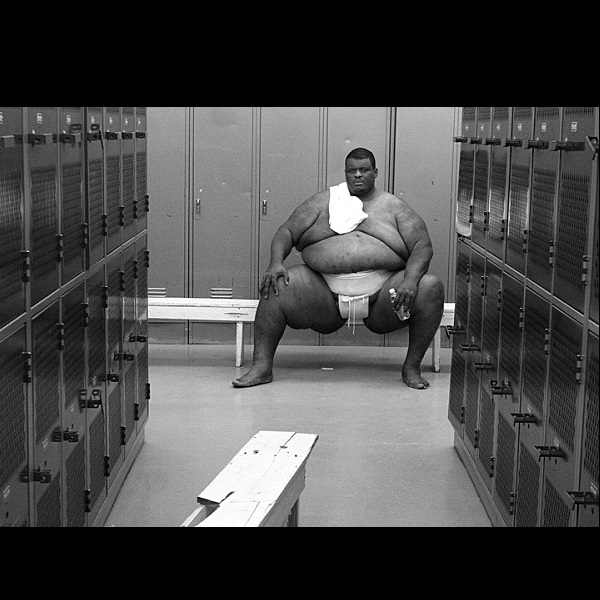
(Photo of Manny Yarbrough courtesy of Beatrice Davis of Sassy B Worldwide Productions.)
On this edition of No Holds Barred, host Eddie Goldman once again spoke with Bob Carson, the host of Carson's Corner.
Our topic was the life and legacy of the sumo wrestler and martial artist Manny Yarbrough, who passed away at age 51 a few days ago.
A GoFundMe page has been set up to raise funds to transport his body from Virginia, where he lived, to New Jersey, where his mother lives, and to assist his family. The page is here.
We spoke with Bob Carson by Skype Wednesday.
Much of what has been written about Manny Yarbrough has come from people who didn't know him or, worse, care about him, and included numerous factual inaccuracies. The people who did know him know that he was not only a giant of a man in stature and size, standing six-foot, eight-inches tall and often weighing over 600 pounds, but he was also a giant of a person, multi-talented, caring, thoughtful.
We discussed how he was a product of the historically Black college Morgan State in Baltimore, where he played football and wrestled, becoming an All-American in both sports, and how his size and talent led him to a career as an athlete. But it also prevented him from being accepted as an athlete and not just a huge guy, and had him kicked out of wrestling because weight limits were put into international and college wrestling during his career.
Manny became an amateur sumo world champion in 1995, but outside of the closely-guarded and often controversial pro sumo in Japan, no one was able to create a successful pro sumo circuit anywhere else, and he was thus unable to capitalize much on his talent in that sport. He fought a few times in MMA, including his famous or infamous loss in 1994 in UFC 3 to Keith Hackney. He got some small parts as an actor, where he showed his talents, but was there mainly because of his size and appearance, and was again stereotyped as just a huge Black guy.
Yet when news of his passing spread online, there was an outpouring of love, grief, and sympathy from many different types of people whom he had touched, including many who had known him at different stages of his life and didn't know each other.
"Manny Yarbrough's legacy and what he's done for wrestling, sumo wrestling, and for anyone out there that potentially is unusual, should be something that is commended and should be something that is appreciated for a long time to come," said Bob Carson.
"We can all become better people, I think, by really looking at Manny and how he acted and how he really conducted himself."
We also discussed much more about Manny's athletic career, how he seemed never to get his due from the sports organizations with which he worked, the issues related to what has been cited as his "food addiction", why it is another disgrace on our social system that funds have to be raised for such a talented athlete and individual as he was, how the lessons of his life must include the necessity for athletes to organize for the mutual aid and benefit of themselves and other athletes, and much more.
You can play or download No Holds Barred here and here. If one link doesn't work, please try another.
Also, No Holds Barred is available through iTunes.
You can also listen to No Holds Barred via Stitcher through iOS or Android devices or on the web, at http://www.stitcher.com/podcast/no-holds-barred-with-eddie-goldman.
The PodOmatic Podcast Player for iOS is available for free on the App Store.
The No Holds Barred theme song is called "The Heist", which is also available on iTunes by composer Ian Snow.
No Holds Barred is free to listen to and is sponsored by:
Gracie Tournaments, featuring regional, national, and world competitions in submission-only Brazilian Jiu-Jitsu. For more information, go to GracieWorlds.com.
The National Registry for Wrestling, whose mission is to increase wrestling's fanbase, to build a registry of all wrestling fans, to serve as a connecting point for all wrestling fans, and to provide TV and Internet listings for wrestling. For more information, go to NR4W.com.
.
Defense Soap, an effective, deep penetrating body soap with natural antifungal, antiviral, and antibacterial soap ingredients. Defense Soap is the best cleansing body soap for men and women athletes who are involved in contact sports such as MMA, wrestling, grappling, jiu-jitsu, and judo, to help their antifungal, anti-ringworm, anti-jock itch strategy. Check out their web site, at DefenseSoap.com.
Labels: Bob Carson, Carson's Corner, Eddie Goldman, Emanuel, Manny Yarbrough, MMA, No Holds Barred, sumo, Tiny, wrestling